
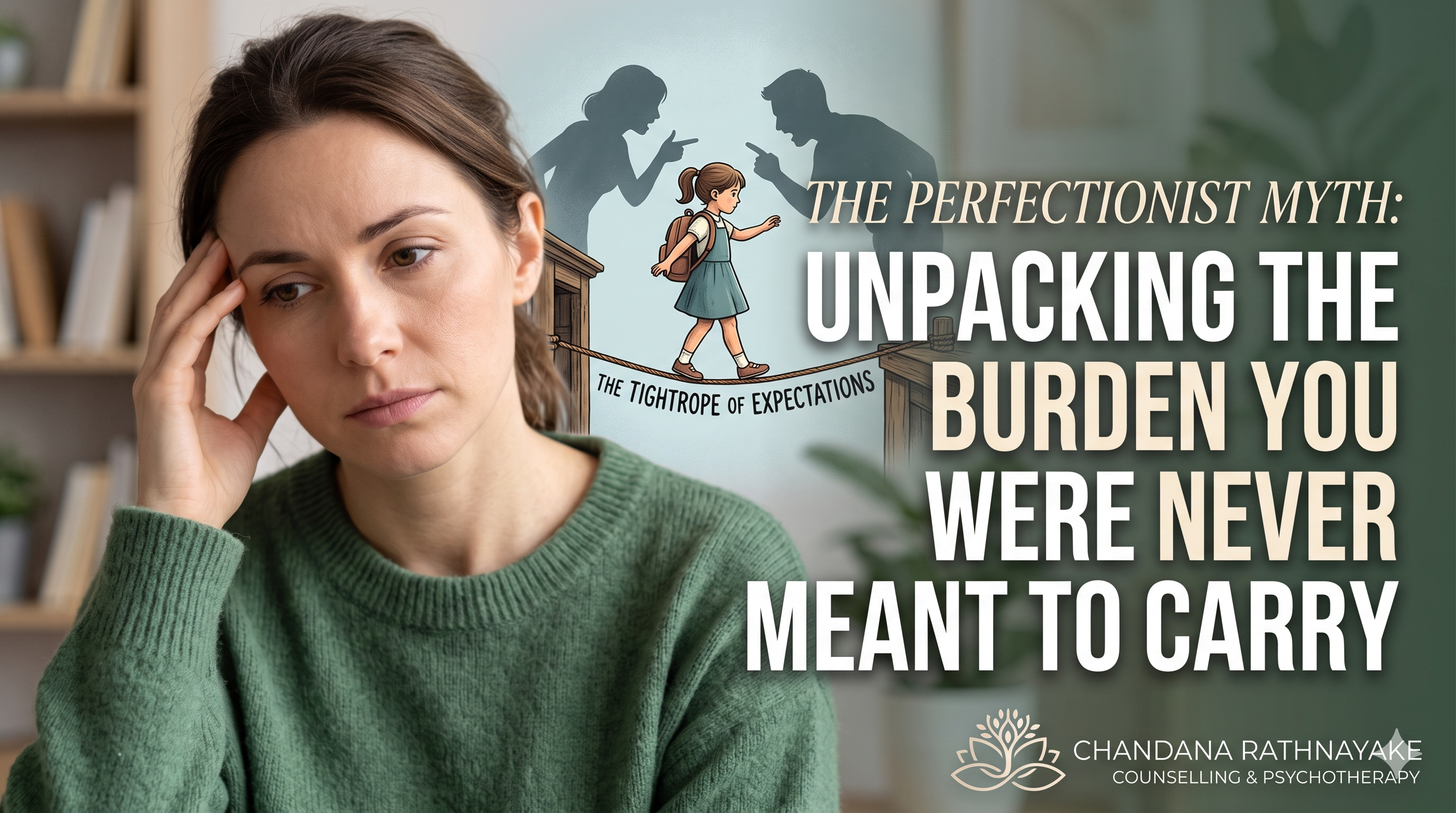
The Perfectionist Myth: Unpacking the Burden You Were Never Meant to Carry
We often wear the label of "perfectionist" like a badge of honor. We tell ourselves—and those around us—that our relentless pursuit of excellence is a trait we chose, a conscious standard we set to ensure our best work and our most successful life. But have you ever stopped to wonder if this burden is actually yours to carry?
For many people navigating the weight of impossible standards, perfectionism is not a personal choice. It is the invisible price paid for someone else’s anxiety—specifically, the fear of failure projected onto you by your parents long before you knew how to define success for yourself.
The Childhood You Didn’t Get to Have
Childhood is designed to be a laboratory of exploration. It is the time for messy experiments, spilled paint, skin-kneed falls, and the fundamental right to get things wrong. Making mistakes is the primary mechanism through which we learn about the world and, more importantly, about our own resilience.
However, when a parent is paralyzed by the fear that their child might "become a failure," that natural environment of curiosity is often replaced by a high-pressure landscape of oversight.
If your parents were governed by this fear, your childhood likely didn’t feel like a space for discovery. Instead, it was likely marked by:
- Constant Over-Correction: Every mistake was treated as a dangerous detour rather than a learning opportunity.
- Persistent Criticism or Nagging: Your performance was continuously scrutinized, leaving you with the feeling that your worth was tied directly to your output or your behavior.
- The Weight of Expectations: Your own interests were often secondary to the need to prove, perform, or protect the family image.
From External Pressure to Internalized Narrative
When you are corrected, criticized, or cautioned against failure repeatedly during your formative years, you begin to adopt that voice as your own. What started as your parents’ anxiety eventually ossifies into your internal monologue.
By the time you reach adulthood, you stop hearing their voices and start hearing your own. You tell yourself, "I just have high standards," or "I’m a perfectionist," failing to realize that this "trait" was a survival strategy you developed to avoid the criticism you grew up with.
Perfectionism was the armor you wore to stay safe, not the path you chose to thrive.
Breaking the Cycle: Reclaiming Your Freedom
The good news is that because perfectionism was not truly yours to begin with, you have the power to put it down. You are not defined by the fear of failure that was passed down to you.
Healing begins when you start to distinguish between your genuine ambitions and the echoes of your parents' anxiety. It involves:
- Acknowledging the Source: Recognizing that your need to be perfect is a response to childhood environments, not an inherent personality flaw.
- Grieving the Childhood You Deserved: Allowing yourself the space to feel the sadness of having your exploration stifled by someone else’s fear.
- Practicing "Productive Imperfection": Intentionally engaging in tasks where you allow yourself to be "good enough," or even "bad," simply to prove to your nervous system that you are still safe.
You do not need to be perfect to be worthy, to be loved, or to be successful. You were born to explore, to learn, and to make mistakes. It is time to let go of the burden that wasn’t yours to carry, so you can finally start living a life defined by your own standards, not someone else's fears.
Are you ready to untangle the roots of your perfectionism?
If you find that your pursuit of "the best" is hindering your ability to enjoy your life and work, I am here to help. Together, we can explore these early patterns in a safe, compassionate environment and help you rediscover the freedom to be authentically, imperfectly you.